Protecting DDC Controllers in Oman: Stabiliser, MOV Surge Protector, or Both?
A DDC controller does not care whether a fault is called a surge, a sag or a brownout. It only sees a supply that has stopped matching its datasheet. The useful question is which of those problems your panel actually has, because the fixes differ, and the most common one, a MOV surge protector, does nothing for two of the first three problems below.
The Short Answer
- A MOV-based surge protective device (SPD) clamps fast spikes. It does not correct sustained low or high voltage, and a sustained overvoltage can push it into thermal runaway.
- A voltage stabiliser corrects sustained sag and swell. It is not a substitute for an SPD.
- A UPS or DC-backed supply covers brief interruptions. Neither of the above does.
- RS-485 data lines (BACnet MS/TP, Modbus RTU) need their own signal-line SPD at the panel entry.
- Which combination you need depends on what your supply actually does. Measure it before you buy anything.
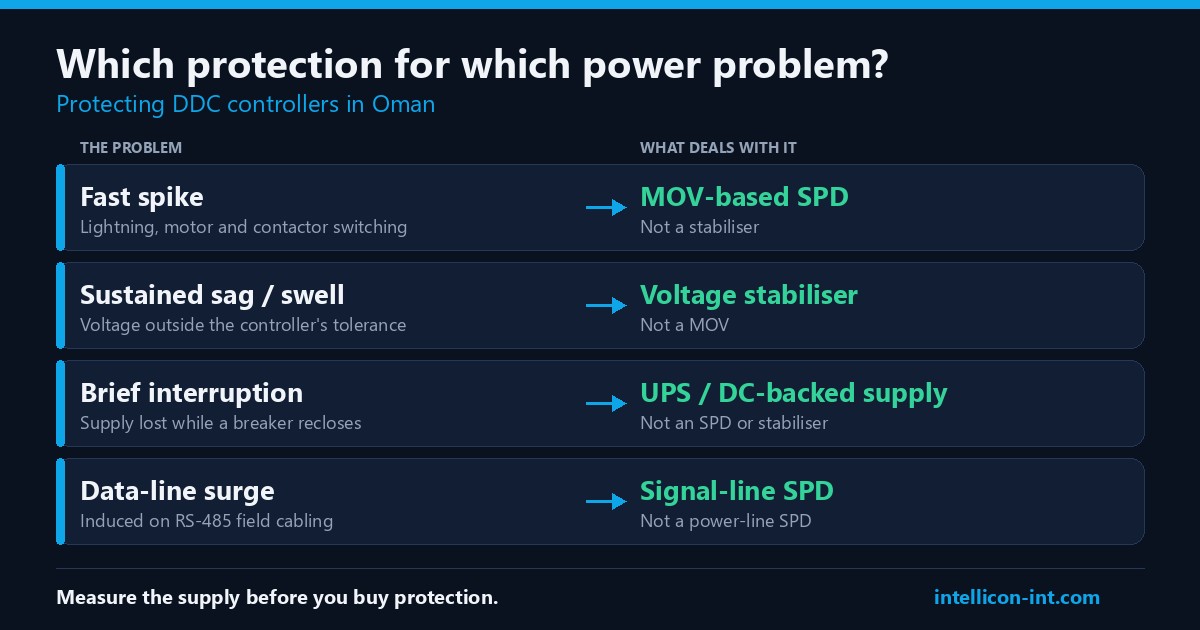
Four Different Problems Hiding Behind “Power Fluctuation”
“Power fluctuation” is a symptom, not a diagnosis. A controller that resets after a thunderstorm, one that drifts out of range every summer afternoon, and one that reboots when a breaker recloses all have different causes and need different equipment.
| Problem | What it is | What deals with it | What does not |
|---|---|---|---|
| Fast voltage spike | A very short, high overvoltage from nearby lightning or from switching motors and contactors. | SPD (MOV-based) at the distribution board and at the panel | A stabiliser corrects the average voltage. It is not a surge protective device. |
| Sustained sag or swell | Voltage that sits below or above the controller’s tolerance for minutes or hours, for example at peak load on a long feeder. | Voltage stabiliser | A MOV does nothing for undervoltage, and can be destroyed by sustained overvoltage. |
| Brief interruption | A short loss of supply, for example while a network breaker auto-recloses to clear a temporary fault. | UPS or a DC-backed controller supply | Neither a stabiliser nor an SPD can supply power that is not there. |
| Data-line surge | A surge induced on RS-485 field cabling that damages a controller’s communication port. | Signal-line SPD at the cable entry (IEC 61643-21) | A power-line SPD does not protect the data lines. |
What Oman’s Grid Code Actually Says
Oman’s nominal supply is 240/415 V at 50 Hz. A voltage is never a single number on a real network, though, so grid codes define permitted bands. A 2021 peer-reviewed paper on Oman’s transmission system, citing the Oman Grid Code, lists these allowable limits:
| Transmission voltage level | Allowable limits |
|---|---|
| 400 kV | ±5% |
| 220 kV | ±10% |
| 132 kV | ±10% |
| 33 kV | ±6% |
Two honest caveats. First, these are transmission-level limits, not the band at a building’s low-voltage panel, and we could not find a verified low-voltage figure, so we do not quote one. Second, the voltage your panel sees is also shaped by everything downstream: the transformer’s tap setting, the length of the feeder and how heavily it is loaded. That is standard network physics, and it is why two buildings on the same grid can see different voltages.
The same paper describes summer as the extreme load case for Oman’s grid, and notes that peak demand keeps rising. It also records that OETC, the transmission operator, advises the users of its network, meaning generators and distribution companies, to protect their systems against load unbalance, overvoltage, undervoltage, over- and under-frequency, and single- and three-phase auto-reclosing.
That guidance was written for grid users, not for building owners, so we draw only a modest conclusion from it, and it is our reasoning rather than a regulatory requirement: if the network operator expects over- and undervoltage and auto-reclosing to be normal events worth protecting against, a building’s controllers should not assume a perfect supply either.
What a MOV Does, and Where It Stops
A metal oxide varistor is the clamping element inside most surge protective devices. It is worth understanding precisely, because its limits are where protection schemes go wrong.
- It is a voltage-dependent resistor. It acts as an open circuit at normal voltage and conducts during transients or when voltage rises above its rated maximum continuous operating voltage (MCOV).
- Its capacity is large but finite. IAEI Magazine identifies electrical puncture, thermal cracking and thermal runaway as the significant failure mechanisms, all resulting from excessive heating. MOVs also degrade with use, so an SPD’s status indicator should be checked and worn modules replaced.
- Sustained overvoltage is its enemy. A temporary overvoltage lasting milliseconds to seconds, for example from a lost neutral or grid switching, can hold a MOV in continuous conduction. It heats, and unless it disconnects it can enter thermal runaway. IEC 61643-11, the product standard for low-voltage power SPDs, tests for this, and compliant devices include a thermal disconnect so they fail safe instead of burning.
- Selection matters. The SPD’s continuous operating voltage must suit the system voltage and earthing arrangement. On Oman’s 240/415 V system that is a specification to check, not to assume from a 230 V datasheet.
The practical consequence: a MOV is excellent against fast spikes and useless against a supply that sits low all afternoon. And on a supply that sits high, a MOV on its own is a liability, not protection.
Where a Small Stabiliser Fits
A stabiliser corrects the average voltage, so it is the right tool when readings at the panel drift outside what the controllers and any 24 V supply transformer accept. King Link Electrical, our UAE manufacturing partner, builds single-phase units from 1 kVA to 10 kVA, servo or static, with a 140–270 V input range and ±1–2% output accuracy. Servo units correct at 15–40 V per second; static IGBT units correct in under a millisecond.
A DDC panel is a small load, so sizing starts from the panel schedule, not from a default. For Oman circuits the unit should be rated for the 240 V nominal: a generic 220 V specification can under-correct. A stabiliser still does not clamp spikes, so it sits alongside an SPD rather than instead of one.
Do Not Forget the Data Lines
Surges do not only arrive on the power feed. BACnet MS/TP and Modbus RTU both run over RS-485 field cabling, and that cabling can act as an antenna between plant rooms or buildings. RS-485 receivers are specified for a common-mode range of roughly −7 V to +12 V. A nearby strike can shift ground potential by far more than that, and the result is a dead communication port that fails silently until someone checks.
The fix is a signal-line SPD suited to data (IEC 61643-21), fitted at the panel’s cable entry with short leads. Use a device designed for signal lines: a standard power-line varistor carries enough capacitance to degrade a high-frequency signal. BACnet and Modbus integration is where these choices are made on our projects.
A Layered Plan for a DDC Panel
- Measure first. Log the supply at the panel for at least a week, including the hottest afternoons, with a power-quality logger. Everything below depends on what it shows.
- Type 2 SPD at the distribution board feeding the panel, to take the larger spikes before they reach the enclosure. Where a building has external lightning protection or an exposed overhead supply, the design may call for a Type 1.
- Stabiliser at the panel incomer, only if the readings justify it, to hold sustained sag or swell inside the controllers’ tolerance.
- Type 3 or DIN-rail SPD close to the controller supply, for the residual spike that gets past the first stage.
- Signal-line SPD on each RS-485 run at the cable entry.
- UPS or DC-backed supply if the controllers must ride through brief interruptions.
- Earthing and bonding. An SPD is only as good as its earth reference, and long leads add inductance that weakens it.
- Trend the supply on the BMS. Voltage and alarm history turn “the controllers keep resetting” from a guess into evidence.
This is general engineering guidance, not a site-specific design. Electrical installation must be carried out by qualified electricians in line with the regulations that apply where the work is done.
Frequently Asked Questions
Does a DDC controller need a stabiliser or a MOV surge protector?
They solve different problems, so many panels need both. A MOV-based surge protective device (SPD) clamps fast voltage spikes. A voltage stabiliser corrects sustained low or high voltage. Neither replaces the other, and neither keeps controllers running through a supply interruption. Which layers a panel actually needs depends on what its supply does, so measure the supply before choosing.
Can a MOV protect against low voltage or brownouts?
No. A MOV behaves like an open circuit at normal voltage and only conducts when voltage rises above its rated maximum continuous operating voltage (MCOV). It does nothing for sustained undervoltage. A sustained overvoltage above its rating is worse than useless for a MOV: it can drive the device into continuous conduction and thermal runaway, which is why compliant SPDs include a thermal disconnect.
What voltage limits does the Oman Grid Code set?
A 2021 peer-reviewed paper on Oman’s transmission system, citing the Oman Grid Code, lists allowable voltage limits of ±5% at 400 kV, ±10% at 220 kV and 132 kV, and ±6% at 33 kV. These are transmission-level limits, not the band at a building’s 240/415 V panel, which also depends on transformer tap settings, feeder length and loading. We have not quoted a low-voltage figure because we could not verify one.
Can summer peak load in Oman affect the voltage at my building?
The same paper describes summer as the extreme load case for Oman’s grid. Higher loading increases voltage drop along feeders and transformers, so the voltage at a distant panel can sit lower at peak. How much, if at all, depends on your feeder and your transformer’s tap setting. Only readings taken at your own panel over a hot week will show it.
Do RS-485 data lines (BACnet MS/TP, Modbus RTU) need surge protection?
Often, yes, particularly where cable runs leave the building or connect separate plant rooms. RS-485 receivers are specified for a common-mode range of about −7 V to +12 V, and a nearby surge can shift ground potential by far more than that, damaging the port. A signal-line SPD suited to data (IEC 61643-21) fitted at the cable entry, with short leads, addresses this. A power-line varistor is the wrong device for a data line because its capacitance degrades the signal.
How big a stabiliser does a DDC panel need?
Add up the panel’s VA from its schedule — controllers, I/O modules, any 24 V transformer and other loads — then add headroom. A DDC panel is a small load, and King Link’s single-phase stabilisers start at 1 kVA (servo or static). Send us the panel schedule and we will size it. For Oman circuits the unit must be rated for the 240 V nominal, not a generic 220 V specification.
Sources
- Al Omairi, Al Balushi & Okedu (2021), Overview of Oman Power Transmission System and Protection Schemes for Effective Energy Management in Smart Grid Operations, Frontiers in Energy Research 9:724501
- IAEI Magazine (March 2004), Metal Oxide Varistor Degradation
- Wikipedia, Mains electricity by country (Oman 240/415 V, 50 Hz)
- IEC 61643-11 (low-voltage SPDs, power) and IEC 61643-21 (SPDs for telecommunications and signalling networks)
- TIA/EIA-485 (RS-485 electrical characteristics)
Checked 29 September 2026. Oman Grid Code limits are as reported in the 2021 paper above, not read from the Grid Code itself.
Protecting DDC Panels in Oman?
Send us the panel schedule, or just the controller model list, and a week of supply readings if you have them. We will tell you which layers your panels need, and which they do not.
Request Panel Protection Advice